
GLP‑1 Peptide Comparison: Reta vs Tirz vs Sema vs Maz vs Cagri
GLP‑1 Peptide Comparison: Reta vs Tirz vs Sema vs Maz vs Cagri
A clear, research‑based breakdown of Retatrutide, Tirzepatide, Semaglutide, Mazdutide, Cagrilintide, the Tirz+Reta combo vial, and oral Orforglipron – plus why using the same mg across compounds is the fastest way to get the science wrong.
Understanding the GLP‑1 Peptide Comparison: Reta vs Tirz vs Sema vs Maz vs Cagri
The peptide research world moves fast, and if you’ve been anywhere near peptide forums lately, you’ve probably seen these names tossed around like they’re interchangeable. Sema, Tirz, Reta, Maz, Cagri, the combo vial, and now the oral one. It’s a lot.
Here’s the truth: they are not interchangeable. Each compound was engineered to hit a different combination of hormone receptors, and that changes everything – how it performs in the research subject, what side effects show up, and how it gets dosed.
This guide breaks down each compound clearly, without fluff or forum myths, and explains the receptor science so the differences actually make sense.
*This post may contains affiliate links. If you make a purchase through one of these links I will receive a commission at no extra cost to you. *This publication is not medical advice.
Quick Biology Cheat Sheet
Before diving into each compound, here are the four building blocks every GLP‑1‑class discussion depends on:
- GLP‑1 slows digestion and signals fullness.
- GIP improves insulin handling and fat metabolism.
- Glucagon receptor activity increases energy expenditure.
- Amylin is a separate hormone system that also slows digestion and reduces appetite.
Everything below is just different combinations of these.
Semaglutide (Sema): The Single‑Target Baseline
Full name: Semaglutide
Receptor targets: GLP‑1 only
Semaglutide is the original single‑target compound. It slows digestion and increases satiety. Because it only hits GLP‑1, its behavior is predictable and well‑mapped. Every newer compound is compared against it.
Tirzepatide (Tirz): The GLP‑1 + GIP Dual Agonist
Full name: Tirzepatide
Receptor targets: GLP‑1 + GIP
Tirzepatide adds GIP to Semaglutide’s GLP‑1 mechanism. This second target improves insulin sensitivity and fat metabolism, and head‑to‑head trials generally show greater average weight reduction than Semaglutide at matched doses.
The dosing issue: milligrams are not interchangeable. Five milligrams of Tirzepatide is not five milligrams of Semaglutide. Potency and receptor binding differ entirely.
Retatrutide (Reta): The Triple‑Agonist Heavyweight
Full name: Retatrutide
Receptor targets: GLP‑1 + GIP + Glucagon
Retatrutide adds glucagon receptor activity on top of GLP‑1 and GIP. This third target increases energy expenditure, not just appetite reduction.
Higher‑dose cohorts in trials reported weight reductions over 24 percent at 48 weeks. This is among the strongest data for any single compound in this category.
Because it hits three receptors, slow dose escalation is essential due to increased GI side‑effect potential.
Mazdutide (Maz): GLP‑1 + Glucagon Without GIP
Full name: Mazdutide
Receptor targets: GLP‑1 + Glucagon
Mazdutide is often mistaken for Tirzepatide’s cousin, but it skips GIP entirely. It pairs GLP‑1 with glucagon activity, similar to part of Retatrutide’s profile but without the third target.
Phase 3 data showed weight reductions up to about 14 percent at 48 weeks, with mild to moderate GI effects.
Mazdutide has its own distinct performance and side‑effect pattern.
Why the GLP‑1 Peptide Comparison Between Reta, Tirz, Sema, Maz and Cagri Actually Matters
Cagrilintide is not a GLP‑1 compound. It works through amylin, a separate hormone system. It slows digestion and reduces appetite through a different pathway.
It is often studied alongside Semaglutide (CagriSema), and the combination shows significantly greater weight reduction than Semaglutide alone. Solo Cagrilintide still produces meaningful reductions, around 10–11 percent versus placebo.
The combination also increases nausea and vomiting rates, though dropout rates remained low.
Cagrilintide (Cagri): The Amylin Analog
Full name: Cagrilintide
Receptor targets: Amylin/Calcitonin
Cagrilintide is not a GLP‑1 compound. It works through amylin, a separate hormone system. It slows digestion and reduces appetite through a different pathway.
It is often studied alongside Semaglutide (CagriSema), and the combination shows significantly greater weight reduction than Semaglutide alone. Solo Cagrilintide still produces meaningful reductions, around 10–11 percent versus placebo.
The combination also increases nausea and vomiting rates, though dropout rates remained low.
The Tirz + Reta Combo Vial: Interesting Idea, No Published Data
This compounded blend combines a dual agonist (Tirzepatide) with a triple agonist (Retatrutide). That means overlapping GLP‑1 exposure plus stacked GIP and glucagon activity.
There are no published trials on this combination. Each compound has its own research program, but the combo does not. Overlapping mechanisms can stack side effects in ways that have not been formally studied.
This is uncharted territory.
Orforglipron (Oral): The Non‑Peptide GLP‑1 Pill
Full name: Orforglipron
Receptor targets: GLP‑1 (small‑molecule oral agonist)
Orforglipron is not a peptide. It is a small molecule designed to survive digestion, making oral dosing possible.
Phase 3 ATTAIN‑1 data showed up to 11.2 percent weight reduction at the highest dose over 72 weeks. Results are lower than the strongest injectables, but it requires no injections.
If avoiding needles matters more than achieving the highest possible number, this is a different value proposition.
What the GLP‑1 Peptide Comparison Shows About Receptor Targets and Potency Differences
Rapid weight reduction can create skin laxity, especially in the face, arms, and midsection. Facial volume loss is documented and often referred to online as “Ozempic face.”
Key considerations:
- Microdosing + slower titration is gentler on skin.
- Cellular-level hydration (save 25% on my Hydration Plan and dispensary-wide) matters for collagen production.
- Supporting skin elasticity with simple but delicious protein intake during weight change is easier than correcting laxity afterward.
Why Mg‑for‑Mg Doesn’t Work
A milligram of Semaglutide is not the same as a milligram of Tirzepatide, Retatrutide, or Mazdutide. Each compound has its own receptor binding affinity and potency curve.
There is no universal conversion chart. Each compound requires its own titration schedule based on its own published data.
Borrowing a dose from one compound and applying it to another is guesswork.
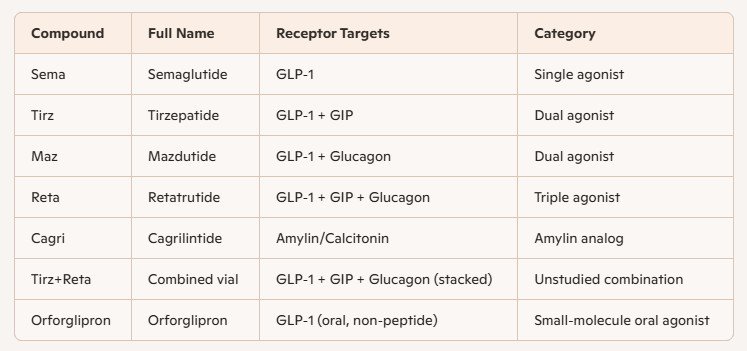
Quick Reference Table
FAQ
Is Tirz just a stronger Sema?
- No. The added GIP target changes the mechanism, not just the strength.
Can I use a Sema dose as a Tirz or Reta starting point?
- No. Different potency means different dosing entirely.
Is Cagri a GLP‑1 drug?
- No. It is an amylin analog, a separate hormone system.
Is the Tirz+Reta vial clinically studied?
- No published data exists on the combination.
Why choose Orforglipron over an injectable?
- No needles and a non‑peptide mechanism. The tradeoff is somewhat lower results than the strongest injectables.
Does rapid weight loss affect skin?
- Yes. Microdosing, hydration, and simplifying protein intake help reduce or eliminate laxity.
Bottom Line
Each compound earns its place by doing something genuinely different. Understanding receptor targets, trial data, and dosing logic is essential. Using mg‑for‑mg conversions is not just inaccurate – it is the fastest way to misunderstand how these compounds actually work.
If you are sourcing any of these for research, use vendors with verified purity testing and transparent sourcing. Mechanism matters, but so does quality.
Research Use Only – These products are intended as research materials only. This designation allows the use of research chemicals strictly for in vitro testing and laboratory experimentation. All information in this post is for educational purposes only. Bodily introduction of any kind into humans or animals is strictly forbidden by law and is not endorsed by this publication. These products are not drugs, foods, or cosmetics and may not be misbranded, misused, or mislabeled as such. Products should only be handled by licensed, qualified professionals.
xx, Samantha
For educational purposes only. This is not medical advice. Always consult a qualified healthcare provider before making changes to your health protocol.
If this resonated, share it with a woman you know who is still searching for answers. She needs to hear this too!
References
Retatrutide Phase 2 Trial – New England Journal of Medicine
Purpose: Evaluated the safety, tolerability, and weight‑loss efficacy of Retatrutide across multiple dose cohorts in adults with obesity, including analysis of triple‑agonist receptor activity.
Mazdutide in Adults with Obesity – New England Journal of Medicine
Purpose: Assessed Mazdutide’s dual GLP‑1 + glucagon receptor activity, its impact on weight reduction, and its gastrointestinal side‑effect profile over 48 weeks.
Cagrilintide Efficacy and Safety Meta‑Analysis – PubMed Central
Purpose: Reviewed clinical data on Cagrilintide as an amylin analog, including solo use and combination therapy with Semaglutide, focusing on appetite suppression, weight reduction, and tolerability.
Orforglipron ATTAIN‑1 Phase 3 Trial – New England Journal of Medicine
Purpose: Investigated Orforglipron as a non‑peptide oral GLP‑1 receptor agonist, measuring weight‑loss outcomes, daily dosing feasibility, and comparison to injectable GLP‑1‑class compounds.
Tirzepatide vs Semaglutide Comparative Trials – Multiple Sources
Purpose: Compared dual‑agonist (GLP‑1 + GIP) Tirzepatide with single‑agonist Semaglutide to determine differences in metabolic impact, insulin sensitivity, and average weight‑loss outcomes.
Semaglutide Obesity Trials – STEP Program
Purpose: Established baseline GLP‑1‑only efficacy, safety, and dose‑response patterns used as reference points for all subsequent multi‑agonist peptide development.

