
Why SIBO Keeps Coming Back After Treatment
Why SIBO Keeps Coming Back After Treatment: The Real Reason Women Relapse
Learn why SIBO keeps coming back after treatment and what actually stops recurrence. Learn the real root causes of SIBO relapse and the four post‑treatment pillars that support lasting recovery.
Understanding Why SIBO Keeps Coming Back
What You Were Never Told About Recurrence
If you have been treated for SIBO and found yourself right back where you started a few months later, bloated, puffy, uncomfortable, and quietly devastated, this post is for you. Not because I have a miracle cure. But because I have the piece most SIBO recovery conversations never get to. And it is the piece that changes everything.
*This post may contains affiliate links. If you make a purchase through one of these links I will receive a commission at no extra cost to you. *This publication is not medical advice.
You Have Probably Already Been Down This Road
If you are reading this post looking for answers, you have likely already tried at least one of the following:
Conventional / allopathic treatments:
- Rifaximin (Xifaxan) alone or combined with Neomycin or Metronidazole
- Rifaximin combined with Neomycin for IMO (methane-dominant)
- Prokinetics, prescription
Holistic / natural treatments:
- Low-FODMAP diet
- Elemental diet
- Herbal antimicrobial protocols, berberine, oregano oil, neem, allicin
- Prokinetics, herbal
- Biofilm disruptors
- Digestive enzymes and HCL support
You did the research.
You found a practitioner or figured it out yourself. You committed to the protocol. And it worked, for a while. Maybe your symptoms improved significantly. Maybe you felt almost normal again. Maybe you let yourself hope that this time it was really gone. And then slowly, or suddenly, it came back.
That is not failure. That is an incomplete picture. And that is exactly what we are going to talk about today.
The Key Reason Why SIBO Keeps Coming Back After Treatment
To understand recurrence, you have to understand something most gut health content glosses over: SIBO is not an infection. It is a condition.
Which means antibiotics, herbal or allopathic, can reduce the bacterial overgrowth. They can clear the small intestine enough for symptoms to lift. But they cannot fix the underlying reason the bacteria overgrew in the first place.
And if that root cause is not addressed, the bacteria come back. Sometimes within weeks. Sometimes within months. Almost always eventually.
In most cases, recurrence comes down to one thing: your gut’s natural self-cleaning mechanism was not working properly before treatment, and treatment alone does not restore it.

The Migrating Motor Complex – The Part Nobody Explains
Your small intestine has a built-in housekeeping system called the Migrating Motor Complex, or MMC. Between meals, during fasting windows, your MMC runs sweeping cycles through your small intestine, moving bacteria, debris, and undigested material down and out before they have a chance to accumulate.
Think of it like a tide that clears the shore between waves.
When the MMC is functioning well, bacteria do not get a chance to overgrow in the small intestine because they keep getting swept into the large intestine where they belong. When the MMC is sluggish, dysfunctional, or suppressed, bacteria stagnate. They accumulate. They overgrow. And SIBO develops, or returns.
This is why you can complete an entire treatment protocol perfectly and still relapse. Because treatment addresses the overgrowth. It does not address the MMC dysfunction that allowed it to happen.
The Recurrence Timeline Nobody Warns You About
Most women who relapse follow a recognizable pattern:
- Weeks one through six post-treatment: Symptoms are better. Sometimes significantly. You feel relief, real relief. You eat more freely. You feel hopeful.
- Months two through four: Something starts to feel slightly off. Maybe the bloating is creeping back. Maybe you feel heavier in your midsection again. You tell yourself it is probably just a bad food day.
- Months four through six: The symptoms are undeniable. The puffiness is back. The discomfort is back. The skin has dulled again. And you are back at square one wondering what you did wrong.
Sound familiar?
Here is what I need you to hear: you did not do anything wrong. You finished treatment without a post-treatment plan. And that gap, that space between treatment complete and sustainable recovery, is exactly where recurrence lives.
The Signs SIBO Is Coming Back
Before we talk about how to stop the cycle, let us talk about what early recurrence actually feels like, because catching it early matters.
These are the signals worth paying attention to:
Digestive signs:
– Bloating returning after meals, especially the upper abdomen
– Tight fullness disproportionate to what you ate
– Increased gas after previously tolerated foods
– Constipation or loose stools returning or alternating
– Nausea after meals that had settled down during recovery
Visible / beauty signs:
– Facial puffiness returning around the jaw, cheeks, and under the eyes
– Dull, slightly grey complexion
– Skin that looks inflamed even without trigger foods
– Midsection bloating that does not deflate overnight
– That familiar “something is off” look
Systemic signs:
– Brain fog returning
– Low-grade unwell feeling
– Increased food sensitivities
– Anxiety or mood changes following digestive flares
– Disrupted sleep without an obvious reason
If several of these feel familiar right now, this post, and the plan at the end of it, is exactly where you need to be.
Why Women With Autoimmunity Are More Vulnerable to SIBO Recurrence
This is the part that most SIBO content misses entirely, and it is the part that matters most for you. If you are living with an autoimmune condition, Hashimoto’s, lupus, RA, MS, Sjögren’s, or any of the others, your recurrence risk is significantly higher than average.
Here are the most common reasons why:
This is not meant to be discouraging. It is meant to explain why a standard post-treatment protocol that works for someone without autoimmunity may not be enough for you, and why your recovery plan needs to account for your nervous system, your immune system, and your lived experience of chronic illness, not just your gut bacteria.
- Chronic nervous system activation
Autoimmune disease keeps your body in a low-grade state of alert. Your immune system is chronically activated. Your nervous system is chronically dysregulated. And your gut, deeply connected to your nervous system through the vagus nerve, cannot run its MMC cycles properly in a body that does not feel safe.
- Increased intestinal permeability
Many autoimmune conditions are associated with compromised gut barrier function. This creates a cycle: leaky gut contributes to immune activation, which contributes to more gut permeability, which creates an environment where bacteria thrive.
- Motility disruption
Several autoimmune conditions, particularly those involving the thyroid and connective tissue, directly affect gut motility. A sluggish gut is a recurrence-prone gut.
- Chronic stress and cortisol dysregulation
Living with chronic illness is stressful in a quiet, persistent way that keeps cortisol elevated and the nervous system stuck in protection mode. Elevated cortisol directly suppresses gut motility.
What Most Post-SIBO Protocols Get Wrong
Here are the most common mistakes women make after SIBO treatment:
- Going straight back to conventional / processed foods
- Adding too many supplements at once
- Skipping nervous system support entirely
- Not protecting MMC windows
- Treating sleep as optional
- Having no plan at all
What Recovery Can Actually Look Like Week by Week
Post-SIBO recovery is not linear. But there is a general rhythm that tends to emerge when the right foundations are in place:
- Week one to two: Your gut is recalibrating.
- Week two to four: Less morning puffiness, more predictable digestion, better sleep quality.
- Month two: Visible shifts begin.
- Month three and beyond: Maintenance phase, where relapse happens without a plan.
A Note on Healing That Shows
- A dysregulated gut shows up on your face.
- The painful puffiness around your jawline and cheeks.
- The dull, slightly grey complexion.
- The under-eye swelling.
- The midsection that stays bloated no matter how clean you eat.
- The skin that looks inflamed even on your good days.
These are not random. They are signals. When your small intestine is overgrown with bacteria, your immune system is chronically activated. Inflammatory signaling is elevated. Your body is in protection mode.
And protection mode does not just affect how you feel. It affects how you look.
Which is why post-SIBO recovery, the part that happens after treatment, is not just about preventing recurrence. It is about giving your body the conditions it needs to finally come out of protection mode and start expressing health.
In your digestion. In your face. In your skin. In your confidence. In your body. That is the part most people miss. And that is definitely a part worth doing this for.
The Four Pillars of Post-SIBO Recovery
Based on what experts consistently emphasize, and what I have seen make the biggest difference, sustainable SIBO recovery comes down to four pillars:
- Motility support
- Movement
- Nervous system regulation
- Evening wind-down and sleep quality
These four pillars work together. Skip one and the others are less effective. Honor all four and your body has everything it needs to stabilize, rebuild, and stay recovered.
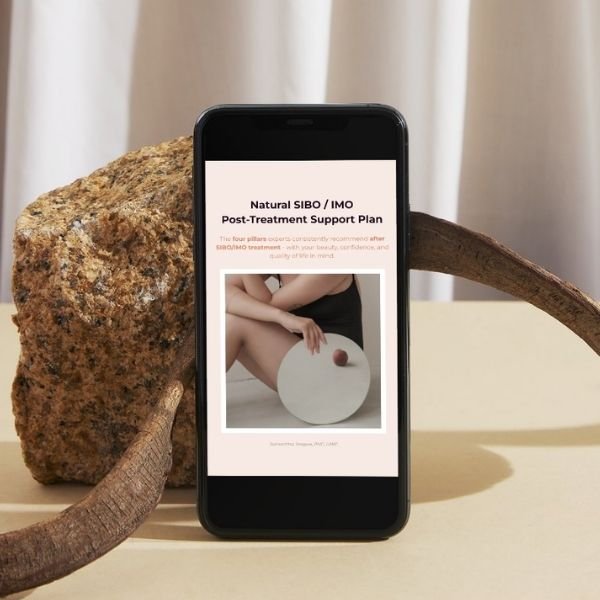
Get the Free Download – Your Post-SIBO Recovery Starts Here
Most women finish SIBO treatment and then just wait. They hope the symptoms stay away. They eat carefully. They cross their fingers.
And then three months later, sometimes six, sometimes less, the bloating creeps back. The puffiness returns. The skin dulls. The midsection swells again. And they feel like they are back at square one.
Here is what I want you to understand: that is not failure. That is a missing piece. And that missing piece is exactly what I built this plan around.
The Natural SIBO / IMO Post-Treatment Support Plan is the resource I wish existed when I was in the thick of my own gut healing. It is not another treatment protocol. It is not a list of supplements to cut or foods to avoid.
It is a complete post-treatment roadmap built around the four pillars that experts consistently identify as the difference between women who relapse and women who rebuild.
Here is what is inside:
✔ The four pillars explained
✔ Daily check-offs
✔ The why behind every step
✔ Motivational support
✔ Supplement guidance
✔ Dietary support
✔ A full daily checklist
And it is built specifically for women with autoimmunity.
👉 Download your free Natural SIBO / IMO Post-Treatment Support Plan here
xx, Samantha
For educational purposes only. This is not medical advice. Always consult a qualified healthcare provider before making changes to your health protocol.
If this resonated, share it with a woman you know who is still searching for answers after treatment. She needs to hear this too!
References
1. SIBO Recurrence & Treatment Response
SIBO and intestinal methanogen overgrowth: breath test performance, treatment response, and relapse – systematic review & meta‑analysis The Egyptian Journal of Internal Medicine, Springer Nature This review documents high relapse rates after antibiotic therapy, especially in methane‑dominant cases, supporting your statement that treatment clears overgrowth but not root causes.
2. Gut Motility & MMC Dysfunction
The importance of food quality, gut motility, and microbiome in SIBO development and treatment Nutrition, 2024 (ScienceDirect) This review explains how impaired motility and disrupted MMC cycles contribute to SIBO development and recurrence – directly reinforcing your “SIBO is a motility disorder, not an infection” framework.
3. Autoimmunity & Motility Disorders
Eradication of Small Intestinal Bacterial Overgrowth in Systemic Sclerosis: Current Treatment and Perspectives Biomedicines, 2025 (PMC) Shows how autoimmune conditions (e.g., systemic sclerosis) impair motility, increase dysbiosis, and dramatically raise SIBO recurrence risk – supporting your section on why women with autoimmunity relapse more often.
4. Gut–Brain Axis, Stress, and Motility
IBS and SIBO: Gut Microbiota, Pathophysiology, and Non‑Pharmacological Interventions Antibiotics (MDPI), 2026 Discusses gut–brain axis dysregulation, stress‑related motility suppression, and the role of nervous system activation – aligning with your explanation of chronic stress, cortisol, and vagal tone affecting MMC.
5. Comprehensive SIBO Etiology & Motility
Unraveling the Complexities of Small Intestinal Bacterial Overgrowth Medicina (MDPI), 2026 A broad review covering SIBO’s multifactorial causes, including motility disorders, structural issues, dysbiosis, and why antibiotics alone rarely produce lasting resolution – supporting your “SIBO is a condition, not an infection” framing.

