
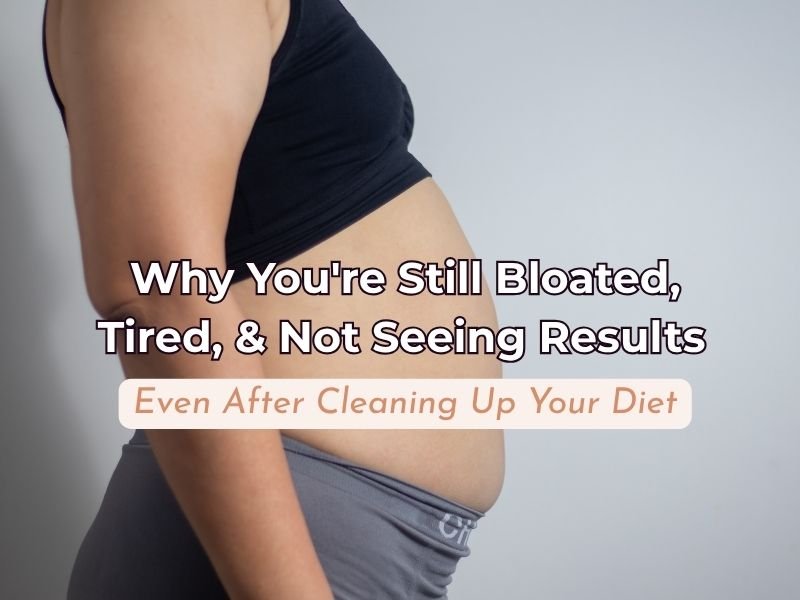
Why You’re Still Bloated, Tired, & Not Seeing Results Even After Cleaning Up Your Diet
The Moment You Start Questioning Everything
You know the moment I’m talking about.
You finally committed. You cleaned up your diet. You removed the inflammatory foods, the processed junk, the things you knew weren’t serving you. You started eating intentionally, real food, quality protein, nourishing fats.
Samantha’s Substack is a reader-supported publication. To receive new posts and support my work, consider becoming a free or paid subscriber.
And you waited.
You waited for the bloating to stop. You waited for the energy to come back. You waited to see it in the mirror, the glow, the leanness, the aliveness you knew was possible.
And instead?
You’re still bloated after meals. Still exhausted by 2pm. Still looking at your reflection wondering why your body isn’t reflecting your effort.
If that’s you, I need you to hear this first:
You are not doing it wrong. Your body is not broken. And this is not a willpower problem.
There is a very specific, very fixable reason this happens, and it’s one of the most overlooked pieces in the entire healing and beauty conversation.
Access my Slow Digestion Support Plan and save 25%
The Part Nobody Talks About After You “Clean Up Your Diet”
Here’s what many wellness spaces get wrong:
They treat food quality as the finish line.
Eat clean → feel amazing → look amazing.
But for women who have spent years navigating autoimmunity, chronic stress, hormonal chaos, or restrictive dieting, food quality is only half the equation.
The other half?
Your body’s ability to actually break it down.
This is called digestive capacity, and for a huge percentage of women in this space, it is quietly, chronically underperforming.
Not because you’re doing anything wrong. But because years of stress, gut inflammation, low-fat dieting, and immune dysregulation have depleted the very systems your body needs to process food properly.
What “Proper Digestion” Actually Requires
To break down and absorb protein and fat, the building blocks of collagen, hormones, muscle tone, and radiant skin, your body needs three things working well:
Strong stomach acid (HCl)
- This is the first domino. Stomach acid activates protein digestion, kills pathogens, and signals the rest of the digestive cascade to begin. Low stomach acid is extremely common in women with autoimmune conditions, chronic stress, or a history of antacid use.
Pancreatic enzyme output
- Your pancreas releases enzymes that break down protein, fat, and carbohydrates. When it’s under-producing, which happens with chronic stress, poor diet history, or gut inflammation, food moves through partially undigested.
Bile flow
- Bile, produced by your liver and stored in your gallbladder, is what emulsifies fat so it can be absorbed. If bile is sluggish or thick (common in women with hormonal imbalances or thyroid issues), fat-soluble vitamins like A, D, E, and K don’t absorb properly, and neither does the fat itself.
When any one of these is compromised, you can be eating the most nutrient-dense food on the planet…
…and still be functionally malnourished at a cellular level.
Why This Shows Up in Your Skin, Weight, and Energy
This is where it gets personal. Because this isn’t just a “digestion” conversation. This is a beauty biology conversation.
When you’re not breaking down protein efficiently:
- You don’t have the amino acids to build collagen → skin loses firmness and elasticity
- You don’t have the building blocks for muscle tone → metabolism slows, body composition stalls
- You don’t have the raw materials for hormone production → mood, cycle, and fat distribution suffer
When you’re not absorbing fat-soluble vitamins:
- Vitamin A → skin cell turnover slows, texture becomes rough
- Vitamin D → immune regulation suffers, inflammation rises
- Vitamin K2 → calcium metabolism is disrupted
When digestion is sluggish overall:
- Toxins recirculate instead of clearing → skin becomes dull, reactive, or broken out
- Inflammation stays elevated → weight loss stalls, puffiness persists
- Energy crashes after meals instead of rising
- Your body is trying to “glow.” It just doesn’t have the tools to do it yet.
Signs Your Digestive Capacity Might Be the Missing Link
Read through these slowly. Check in honestly.
- You feel uncomfortably full for 3–4+ hours after eating
- You burp, have reflux, or feel a burning sensation after meals
- You notice undigested food in your stool
- You feel more tired after eating, not energized
- Your bowel movements are inconsistent, sometimes constipated, sometimes loose
- You feel like food just sits in your stomach
- You’ve been eating well for months but your skin, weight, and energy haven’t shifted the way you expected
If you’re nodding at more than two or three of these…this is your missing piece.
What Actually Helps (Without Adding More Restriction)
The answer here is not eating less. It’s not eliminating more foods. It’s not another elimination protocol.
It’s supporting the systems that were depleted so your body can finally do what it’s been trying to do.
There are two categories of enzyme support worth knowing about:
Mealtime Digestive Enzymes (taken with food)
These help break down protein, fat, and carbohydrates in real time. They fill the gap while your body’s own enzyme production is rebuilding. This is where most women start, and where most women notice the fastest shift.
Proteolytic Enzymes (taken away from food, on an empty stomach)
These work systemically, supporting inflammation reduction, tissue repair, and immune modulation. Think of these as the longer-game support.
For most women I work with, starting with mealtime enzymes is the move.
The difference is often felt within days:
- Meals feel lighter
- Energy after eating improves
- Bloating decreases
- And over time, skin, weight, and vitality start to shift
What I Use and Recommend
I’m particular about supplement quality, especially for women with autoimmune conditions where purity and potency actually matter.
I source through Fullscript because of the practitioner-grade, third-party tested products they stock, and their supplements are significantly more bioavailable than most retail options.
Access my Slow Digestion Support Plan here, with 25% off for my community
This is not a “take this forever” situation. It’s a bridge, supporting your body while it rebuilds its own capacity.
The Reframe That Changes Everything
You didn’t fail your diet. Your digestion was just working against you.
And the beautiful thing about the body? When you give it the right support, it responds quickly.
The glow you’ve been working toward, the energy you’ve been chasing, the body that finally reflects your effort, it’s not as far away as it feels. It just needs the right tools to get there.
A Note Before You Go
If you’ve been in this space for a while, doing the research, making the changes, showing up for your health even when it’s hard, I see you. This work is not small.
And your body is responding. Sometimes the missing piece is just this quiet, unsexy, deeply important layer underneath everything else.
Fix the foundation. Watch everything else follow.
Have you noticed that food feels heavy or sits in your stomach even when you’re eating well? Drop a comment, this is one of the most common things I hear from women in this community, and you are not alone.
Save 25% on my Slow Digestion Support Plan
References
Yago MD et al. Gastric acid secretion and its role in protein digestion. Dig Dis Sci. 2001;46(12):2688–2697.
Ianiro G et al. Digestive enzyme supplementation in gastrointestinal diseases. Curr Drug Metab. 2016;17(2):187–193.
Hofmann AF. The continuing importance of bile acids in liver and intestinal disease. Arch Intern Med. 1999;159(22):2647–2658.
Wolfe RR. The underappreciated role of muscle in health and disease. Am J Clin Nutr. 2006;84(3):475–482.
Barrea L et al. Nutrition and skin health: a narrative review. Nutrients. 2020;12(9):2571.

