

Is Your Clean Skincare Making Your Autoimmune Skin Worse? Here’s What’s Really Going On
For the woman with Hashimoto’s, eczema, or autoimmune skin who switched to natural skincare and is still dealing with dryness, irritation, and reactions… here’s the real reason why.
This publication contains affiliate links. If you make a purchase I will receive a commission. Your price remains the same. Thank you!
Not medical advice.
You Cleaned Up Your Skincare. So Why Is Your Sensitive Skin Still Reacting?
You know what’s frustrating? Doing years of internal work – the elimination protocols, the gut healing, the anti-inflammatory eating, the supplement stacks – and still looking in the mirror at skin that is dry, reactive, inflamed, or just… dull. Not glowing. Not calm. Not reflecting any of it.
And the worst part isn’t even the skin itself. It’s the quiet, exhausting thought that follows: If I’ve done this much and it still looks like this… what am I missing?
I want to answer that question today. Because there is a very specific answer – and it’s not another elimination. It’s not a new supplement. It’s not something you’re eating. It’s what you’re putting on your skin every single day. And more specifically, it’s whether those products are supporting your skin barrier or quietly, consistently destroying it.
The Hidden Reason Natural Products Can Still Irritate Autoimmune Skin
Your skin barrier – technically called the stratum corneum – is the outermost layer of your skin. It’s made up of skin cells held together by a precise matrix of lipids: ceramides, cholesterol, and fatty acids.
Think of it like a brick wall. The skin cells are the bricks. The lipids are the mortar.
When that mortar is intact, your skin holds moisture in, keeps irritants and pathogens out, regulates inflammation, heals and renews efficiently, and looks plump, calm, and luminous.
When that mortar is compromised – even slightly – everything changes. Moisture escapes. Irritants get in. Inflammation rises. And no amount of moisturizer, serum, or internal nutrition can fully compensate for a barrier that’s being disrupted faster than it can repair.
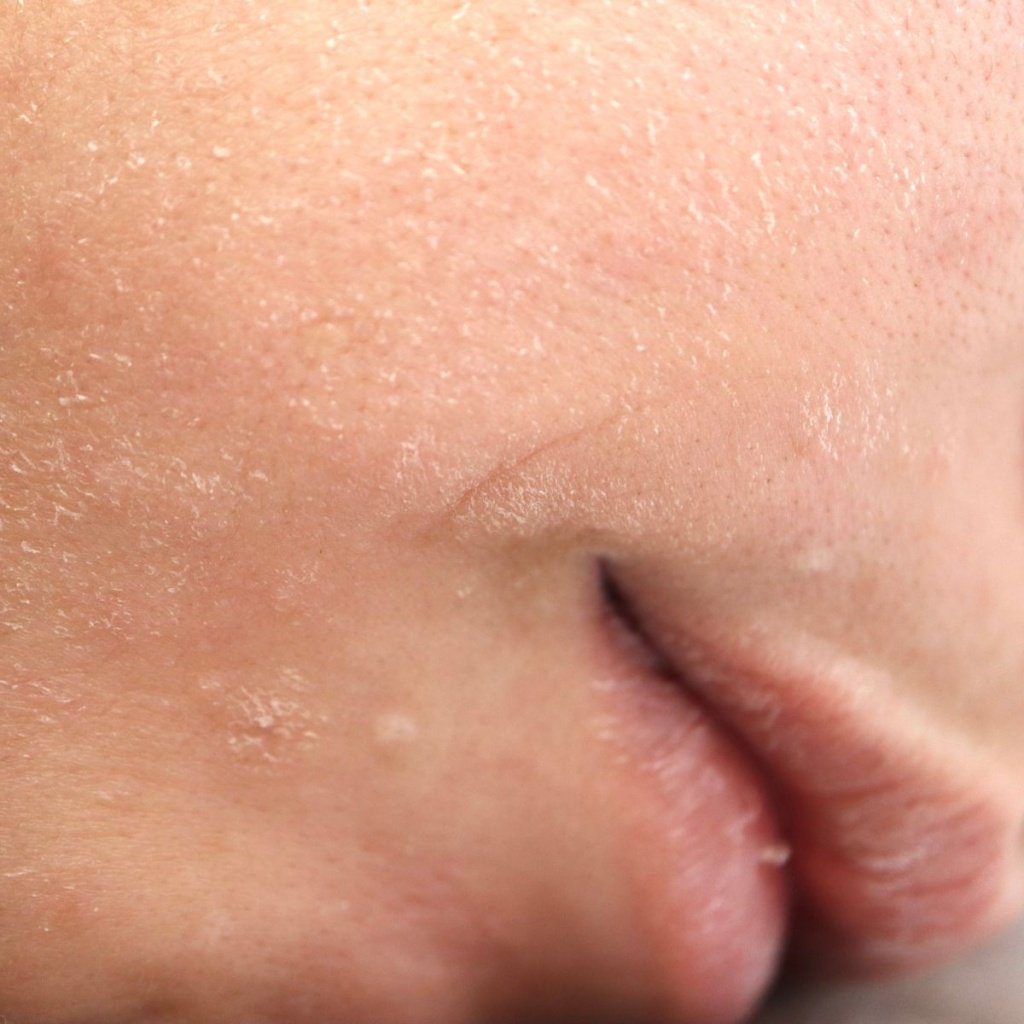
The Loop Most Women Are Stuck In: When Natural Skincare Keeps Irritating Sensitive Skin
Here’s what I see constantly in women who have done significant internal healing work: they clean up their diet, their gut starts to improve, their inflammation decreases internally. But their skin stays reactive. Stays dry. Stays inconsistent.
So they reach for more products. Better moisturizers. Gentler cleansers. “Clean” formulas. And the cycle continues: dry → moisturize → temporarily better → dry again → repeat.
What’s actually happening? Most conventional skincare products – including many that are marketed as natural, clean, or sensitive-skin-friendly – are actively disrupting the barrier they claim to support.
Here’s how: surfactants and cleansers strip natural oils. Even “gentle” cleansers remove the skin’s natural sebum and lipid layer. Do this daily and you’re constantly starting from a deficit.
Unstable plant oils oxidize on the skin. Many “clean” moisturizers are loaded with linoleic-acid-rich seed oils – sunflower, rosehip, marula, hemp. These oils oxidize quickly, generate free radicals on the skin surface, and can actually increase inflammation in barrier-compromised skin.
Fragrance – natural or synthetic – is one of the top barrier disruptors. Essential oils, botanical extracts, and synthetic fragrance all trigger immune responses in sensitized skin. “Natural” does not mean non-reactive.
Preservatives disrupt the skin microbiome. The preservatives required to keep water-based products shelf-stable – even “clean” ones – alter the microbial balance on your skin, which directly impacts barrier function and immune regulation.
So you’re applying products to fix dryness and reactivity… that are causing dryness and reactivity.
This is not a you problem. This is a formulation problem.
Shop Stone & Spear Tallow – use code PRIMALSAM for 10% off →
Why Autoimmune Conditions Make Your Skin React to Almost Everything… Even “Safe” Products
For women managing autoimmune conditions, the skin barrier conversation is even more critical.
Here’s why: immune dysregulation directly impacts barrier function. Conditions like Hashimoto’s, lupus, psoriasis, and eczema are all associated with measurable barrier dysfunction – not just as a symptom, but as part of the underlying immune dysregulation itself.
Chronic inflammation degrades the lipid matrix. Elevated inflammatory cytokines break down the ceramides and fatty acids that hold the barrier together. This means your skin is fighting a structural battle from the inside and the outside.
Sensitized immune systems react to more. What a healthy immune system ignores, an autoimmune-primed immune system flags. Fragrance, preservatives, certain plant compounds – these become triggers that keep skin in a constant low-grade inflammatory state.
Leaky gut and leaky skin are connected. The same mechanisms that drive intestinal permeability – tight junction dysfunction, immune activation, microbial imbalance – also drive skin barrier permeability. Healing one supports the other. But disrupting the skin barrier can also perpetuate gut inflammation.
This is why skin healing for autoimmune women requires a different approach. Not more products. Not more actives. Not more intervention.
Less disruption. More recognition.

What Autoimmune Skin Actually Needs (And Why Most Natural Skincare Still Gets It Wrong)
Your skin barrier is made of fats. Specifically: saturated and monounsaturated fats, cholesterol, and ceramides. These are the same fats your body produces naturally. The same fats that have been used on skin for thousands of years before the modern skincare industry existed.
When you apply fats that your skin recognizes – structurally similar to what it’s made of – something shifts. The barrier stops being disrupted. It starts being fed. Moisture retention improves. Inflammation calms. Texture smooths. Redness fades. And for the first time in a long time, your skin starts to reflect the internal work you’ve already done.
The Simplest Fix for Chronically Dry, Irritated, Sensitive Skin
This is the product line I come back to again and again for clients with chronically dry or dehydrated skin, eczema-prone or reactive skin, post-inflammatory sensitivity, skin that reacts to “everything,” and autoimmune-related skin conditions.
It’s simple. It’s ingredient-minimal. And it works in a way that most conventional products simply cannot – because it’s working with your skin’s biology instead of against it.
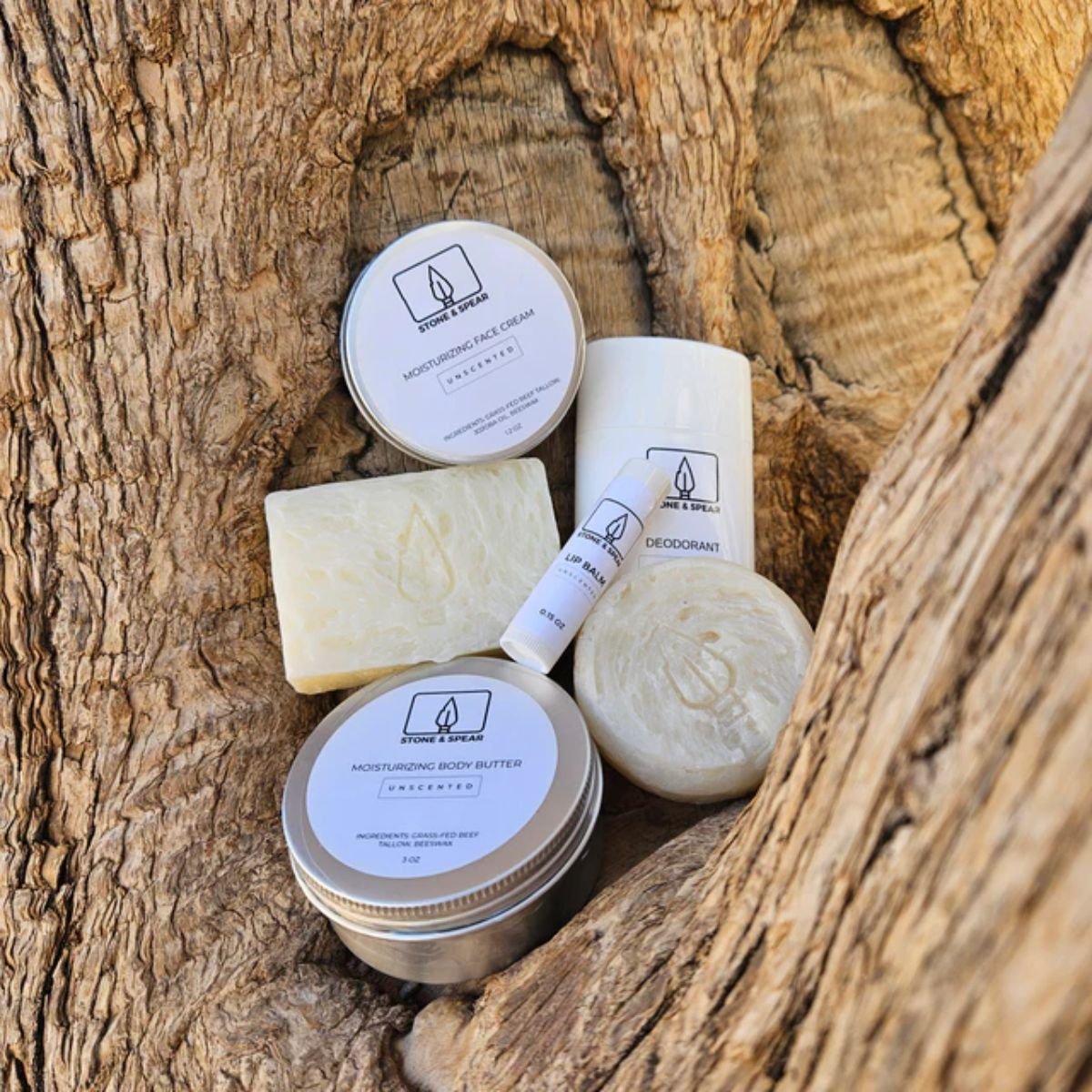
Stone & Spear’s The Clarifying Eczema Bundle is a dermatologist-approved, 6-piece, 100% natural skincare set handcrafted in the USA for treating eczema and sensitive skin. It uses grass-fed tallow and botanical ingredients to hydrate and heal. The brand also offers Tallow Aloe Balm for spot treatment.
Stone & Spear Tallow – Body Butter & Eczema Bundle. Use code PRIMALSAM for 10% off
What I tell my clients: give it a few days. The shift is usually noticeable faster than you’d expect – because you’re not adding something new so much as removing the disruption and replacing it with something your skin already knows how to use.
Your Skin Has Been Trying to Heal All Along.
Here’s the thing about beauty biology: your skin is not a surface to be managed. It’s a living organ – the largest one you have – with its own immune function, microbiome, barrier system, and repair capacity.
When you stop treating it like a problem to be fixed with more products, and start treating it like a system that needs the right inputs and fewer disruptions, everything changes.
The dryness that wouldn’t respond to anything? It responds to this. The reactivity that made you afraid to try new things? It calms when you stop introducing things that trigger it. The dullness that persisted despite your clean diet? It lifts when your barrier is finally intact enough to reflect light the way healthy skin does.
Your skin has been trying to heal. It just needed your products to stop “getting in the way.”
Before You Go, I Want You to Hear This
I know how defeating it feels to have done so much internal work and still not see it on the outside. I’ve been there. Many of the women I work with have been there.
And I want you to know: the internal work is not wasted. It is the foundation. Without it, nothing else holds. But sometimes the missing piece is this external layer – the daily disruption that’s been quietly undoing what your body is trying to build.
Remove the disruption. Feed the barrier. Watch your skin finally catch up to your effort.
You’ve earned this glow. Let’s make sure nothing is standing in the way of it.
Is your skin still reactive or dry despite doing the internal work? Tell me in the comments – this is one of the most common things I hear, and I want to know where you are with it.
Shop Stone & Spear – code PRIMALSAM saves you 10% →

References
Proksch E, Brandner JM, Jensen JM. The skin: an indispensable barrier. Exp Dermatol. 2008;17(12):1063–1072.
Elias PM. Stratum corneum defensive functions: an integrated view. J Invest Dermatol. 2005;125(2):183–200.
Danby SG et al. Effect of olive and sunflower seed oil on the adult skin barrier: implications for neonatal skin care. Pediatr Dermatol. 2013;30(1):42–50.
Thyssen JP, Kezic S. Causes of epidermal filaggrin reduction and their role in the pathogenesis of atopic dermatitis. J Allergy Clin Immunol. 2014;134(4):792–799.
Berin MC, Sampson HA. Mucosal immunology of the gastrointestinal tract and its relationship to skin. J Allergy Clin Immunol. 2013;131(1):3–17.

