
Why EBV and MCAS Make Weight Loss Impossible (Even on GLP-1s)
Discover why EBV and MCAS create a cycle that blocks weight loss, makes GLP-1s stop working, and causes overnight facial puffiness (plus what actually helps).
This publication contains affiliate links. If you make a purchase I will receive a commission. Your price remains the same. Thank you! Not medical advice. Content in this post may be created with the assistance of AI
You have done everything right.
You cleaned up your diet, removed the triggers, supported your gut, calmed your nervous system. And some days, you actually feel a little better. Your energy lifts. Your brain fog clears. You think, finally, this is working.
Then you look in the mirror.
Your face is puffy. Your features look softer, less defined. Your under-eyes are swollen. The scale jumped three pounds overnight even though you ate the same thing you always eat. And you feel that familiar frustration rising: Why does my body look worse when you are actually trying so hard?
Here is what no one tells you: that disconnect between feeling better and looking worse is not random. It is not your body failing you. It is actually your body protecting you in the only way it knows how when EBV and mast cells are in conversation with each other.
Let me show you what is really happening under the surface and why understanding this changes everything.
The EBV-MCAS Inflammatory Loop: Why Your Body Gets Stuck
You already know what EBV and MCAS are. You have read the articles, done the protocols, tried the supplements. What you might not know is how they interact inside your body to create this specific pattern: feeling better but looking inflamed.
Here is the cycle that is running in the background:
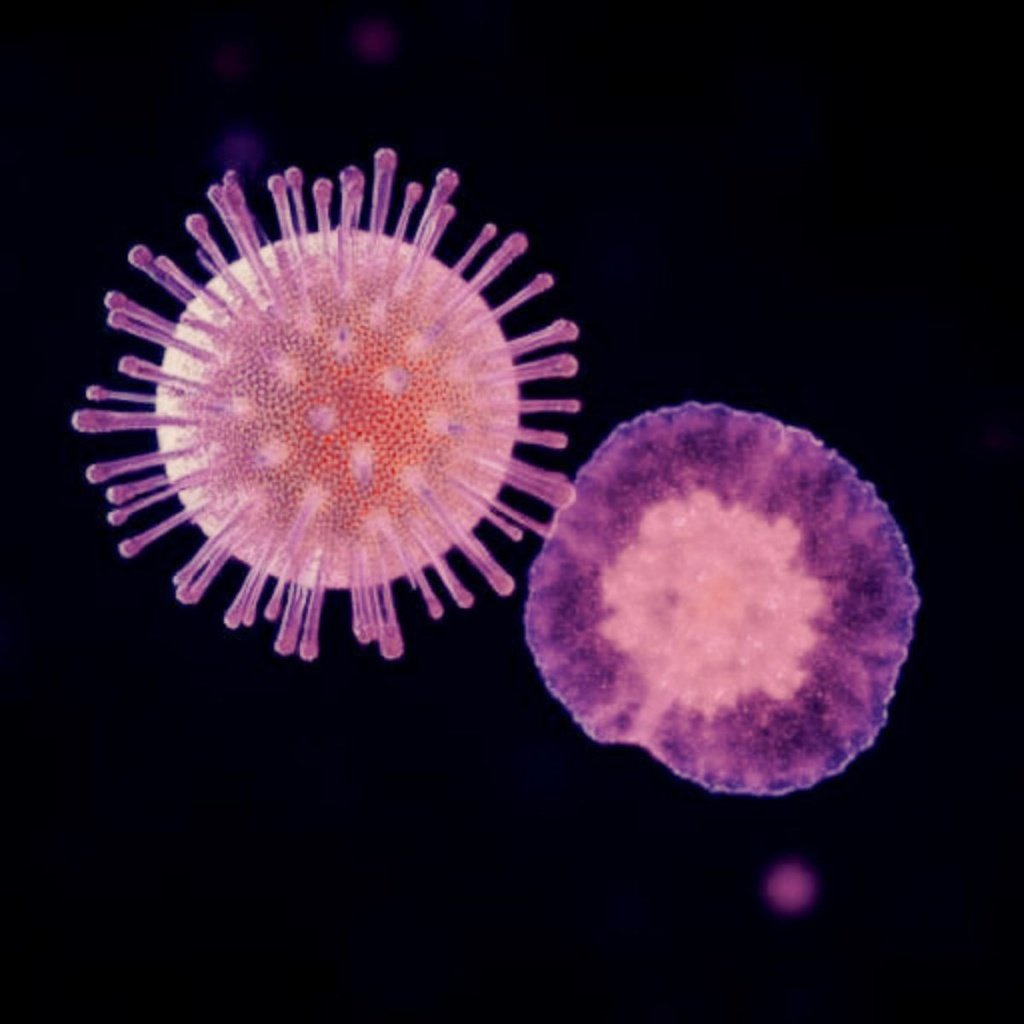
When EBV becomes more active (even slightly), your mast cells detect it. They are doing their job. They are supposed to respond to viral activity. But when mast cells fire, they release histamine and inflammatory cytokines like IL-6 and TNF-alpha. And here is the problem: those inflammatory signals actually wake EBV up more. So EBV gets more active, which triggers more mast cell firing, which creates more inflammation, which activates more EBV.
Around and around it goes.
This is not a failure of your immune system. This is your immune system responding exactly as it is designed to. It is just stuck in a loop it cannot break on its own.
And this loop has visible consequences that show up in your face, your weight, and your skin faster than anywhere else.
Want to know which EBV labs to order?
Shop the Integrative Labs Here at a Discount
Then share my free guide with your integratively-literate physician: Understanding Your EBV Lab Results
Overnight Weight Gain: Understanding Protective Fluid Retention
Let us talk about the weight gain that makes absolutely no sense.
You wake up one morning and the scale is up two pounds. Sometimes four. Sometimes seven. You did not eat differently. You did not fall off your protocol. You did not do anything wrong. Yet your body looks and feels heavier, softer, puffier, especially in your face.
This is not fat. This is what I call protective fluid.
When your immune system senses a threat, like viral activity combined with mast cell activation, your body shifts into a protective state. Your blood vessels become more permeable. Inflammatory signals increase. And your body holds onto fluid inside your tissues as a buffer, a cushion, a protective layer while it is navigating this internal crisis.
Think of it like emergency supplies during a disaster. Your body knows something is happening, a virus waking up, an immune response running hot, tissues becoming inflamed. So it grabs extra fluid and stores it where tissues can use it to cushion the situation.
This creates visible changes that do not follow the rules you have been taught:
- Facial puffiness that appears overnight
- Under-eye swelling that will not respond to sleep or hydration
- Softer, less defined features
- Scale jumps that do not match your food intake
- A heaviness in your body that feels different from regular bloating
Your body is not letting itself go. It is holding you through something.

Facial Puffiness and Inflammation: The Beauty Biology Connection
This is the part that messes with your head the most, especially if you are someone who has worked hard to heal and finally feel like you are making progress internally.
Because your face, your most visible feature, the thing you see every morning, can change overnight in ways that feel devastating. And it does not follow logic. You did not eat more. You did not stop trying. You did not fail.
But your reflection looks different.
Here is what is happening from a beauty biology perspective:
When mast cells fire and inflammation rises, the fluid retention shows up first and most noticeably in your face. Your facial tissues are delicate, highly vascular, and extremely responsive to inflammatory signals. So when your body is holding protective fluid, your face becomes the most visible evidence of that internal state.
This is why you can wake up looking puffy, swollen, or inflamed even when you are technically doing better in other ways. Your body is prioritizing protection over aesthetics. And honestly, that is exactly what it should be doing when it perceives a threat.
But it does not make it any less frustrating to live with.
How EBV and MCAS Shift Your Metabolism Into Emergency Mode
When you are caught in this EBV-mast cell cycle, something else happens that affects how your body looks and responds: your metabolism shifts into emergency mode.
Your metabolism is not just about calories in and calories out. It is your body’s entire resource management system, how it allocates energy, stores reserves, prioritizes functions, and decides what gets attention and what gets put on hold.
When mast cells are firing constantly and your immune system is managing an ongoing viral situation, your metabolism interprets this as crisis. And it adjusts accordingly.
Your body starts conserving energy.
It becomes less efficient at burning calories. It stores fat more readily, not just as adipose tissue, but also as that protective fluid we talked about. It shuffles priorities so that immune function gets more resources, and other systems (like fat burning, muscle building, skin repair) get less.
This is not laziness. This is not poor willpower. This is your body doing exactly what any organism would do when it thinks it is in survival mode: conserve energy, store resources, keep the most critical systems running.
The weight is not coming from eating too much. It is coming from your metabolism deciding that right now, not later, right now, is the time to hold onto everything it can.
And here is the cruel irony: when you respond by trying to fix your metabolism with more aggressive diet restrictions, you are actually signaling another crisis to your body. “Oh, we are definitely in emergency mode now. They are restricting food. Better hold on even tighter.”
GLP-1 Resistance: Why Tirzepatide and Retatrutide Stop Working
If you’re using GLP-1 peptides like Tirzepatide or Retatrutide and you have hit an unexplained weight loss stall, this is probably why.
When EBV reactivates and mast cells fire, they release those inflammatory cytokines we talked about, specifically IL-6 and TNF-alpha. These are not just inflammation markers on a lab report. They are biological roadblocks that literally interfere with how GLP-1 peptides work in your body.
Here is what happens:
What You Are Trying to Do | What Inflammation Does |
GLP-1 signals cells to burn fat | IL-6 blocks GLP-1 receptor signaling |
Metabolism increases efficiency | TNF-alpha creates insulin resistance |
Body releases stored energy | Cortisol rises, promoting storage instead |
Weight loss progresses | Protective fluid increases, scale stalls |
It is like trying to light a fire while someone keeps dumping water on the match. No matter how much fuel you add (increasing the dose), the fire will not catch because the conditions are not right.
Many people respond by increasing their GLP-1 dose, thinking “if a little did not work, maybe more will.” But when your body is in emergency mode due to viral-triggered inflammation, more GLP-1 is not the answer. Your cells are resistant to the signal. Your liver is prioritizing glucose production over fat burning. Your body is storing water as protection.
The weight will not shift until you calm the inflammation first. Then the GLP-1 can finally do what it is designed to do.
Breaking the Cycle: Integrative Support for EBV and MCAS
This is where we stop fighting against your body and start working with it.
Because the goal is not to force your body into submission. The goal is not to override its protective mechanisms with more restriction, more intensity, more willpower. The goal is to make your body feel safe enough to soften, to release, to stop holding on so tightly.
That happens when you address both sides of the loop.
Integrative steps to take to help deactivate EBV:
- Get 25% off my professional Viral Support Protocol Plan inside my dispensary.
- Eat a primal, anti-inflammatory diet free of gluten and sugar
- Support the gut (hello, bone broth, yogurt, and sauerkraut)
- Check for and mitigate other coinfections (Lyme, Candida, SIBO, etc)
- Detox your life (cleaning products, toiletries, toxic people, mold)
- Support gentle daily detox (show extra love to your liver, lymph, and organs with dry brushing, rebounding, sauna, milk thistle, dandelion root, algae-free mulberry chlorophyll, etc)
- Prioritize Quantum modalities (like prioritizing sleep, circadian rhythm, & safe sun exposure)
- Manage stress (this is a BIG one) and calm the nervous system
- Consider rx Valtrex with your doctor since EBV is a herpes strain virus and it helps stop replication of the virus
Integrative steps to help calm down MCAS:
- Review my MCAS Natural Support Plan (save 25% here) with your doctor
- Learn about Microdosing of GLP1 / GIP / Glucagon peptides
- Nervous system support with vagus nerve stimulation, and/or EMDR, EFT/tapping, prayer, meditation, breath work, humming, listening to to birdsong, waterfall, etc
- Rx bandaids: Cromolyn oral, Ketotifen oral, Levocetirizine, Cetirizine, Hydroxyzine,
- OTC bandaids: Claritin, Allegra, Zyrtec
- Holistic bandaids: DAO enzyme (if tolerated), Luteolin, Rutin, PEA, Vitamin C, stinging nettle, bromelain, digestive / fibrinolytic enzymes
- Find the root cause (nervous system, trauma, pathogens *ie: EBV, SIBO, “long COVID”, mold, toxins)
The key is understanding that this is not about doing more and overwhelming yourself. It is about doing what actually signals safety to your body.

Reframing Weight Fluctuations: From Shame to Information
Here is a reframe that changed everything for me: Stop using the scale as judgment. Start using it as information.
When your weight jumps overnight, that is not failure. That is a flare signal. It is your body telling you: “We are inflamed. We are activated. We are protecting.”
Old Interpretation | New Interpretation |
“I gained weight, I am failing” | “My body is holding protective fluid” |
“I need to eat less” | “I need to calm inflammation” |
“My metabolism is broken” | “My body is in emergency mode” |
“I am doing something wrong” | “My body is doing something protective” |
This shift, from shame to information, is what allows you to actually respond in ways that help instead of ways that make the cycle worse.
You are not doing everything right and still somehow messing it up.
You are navigating a body that is highly responsive, deeply protective, and constantly adapting to perceived threats. Of course it is exhausting. Of course you are tired of thinking about it. Of course you want to just look in the mirror and see yourself again without the puffiness, the inflammation, the visible evidence of everything you are dealing with internally.
But this is not random. And it is not permanent.
When you shift from forcing your body to change to working with its protective patterns, when you address the inflammation, calm the mast cells, support your system through the viral load instead of fighting against it, things start to soften.
Your face. Your weight. Your energy. Your reflection.
Not all at once. Not in a linear progression. But enough to feel like yourself again.
And honestly, that is the kind of progress that actually lasts. Because it is not built on restriction or willpower or fighting against your body’s protective mechanisms. It is built on understanding what your body is trying to do and giving it what it actually needs to feel safe enough to let go.

References
Proksch E, Brandner JM, Jensen JM. The skin: an indispensable barrier. Exp Dermatol. 2008;17(12):1063–1072.
Elias PM. Stratum corneum defensive functions: an integrated view. J Invest Dermatol. 2005;125(2):183–200.
Danby SG et al. Effect of olive and sunflower seed oil on the adult skin barrier: implications for neonatal skin care. Pediatr Dermatol. 2013;30(1):42–50.
Thyssen JP, Kezic S. Causes of epidermal filaggrin reduction and their role in the pathogenesis of atopic dermatitis. J Allergy Clin Immunol. 2014;134(4):792–799.
Berin MC, Sampson HA. Mucosal immunology of the gastrointestinal tract and its relationship to skin. J Allergy Clin Immunol. 2013;131(1):3–17.

